I just uploaded around fifty photos to flickr, go check 'em out.
More to come on African Urbanism, Table Mountain, and 90 Rand bottles of wine.

14.3.09

8.3.09
Ordem e Progresso.
In reflecting on the past few weeks in Brazil (and comparing those weeks to the urbane, majestic landscape I find here in Cape Town, South Africa) I can't help but think of the phrase Ordem e Progresso that is proudly displayed across the Brazilian flags I saw flapping in the wind along buildings on Paulista Avenue or enthusiastically waved at soccer games and Carnaval. While "Order" and "Progress" are two concepts that admittedly aren't obvious when seeing either the utter chaos that defines Sao Paulo's pace or the grim realities of life in the favelas, there is some sort of inherent logic to the way the country is modernizing and preparing itself for the next century's commerce and culture. Who stands to benefit from the reinforcement of this "Order" and "Progress?" How are the various actors shaping their country's own order and progress? These questions are especially relevant in Curitiba, a self-proclaimed sustainable ecotopia that makes its money from auto manufacturers and provides ample public transportation so long as you are wealthy enough to afford land inside city limits.
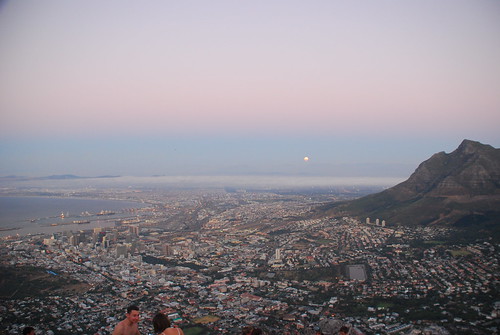
I climbed Table Mountain yesterday, and the view was spectacular. Who on earth thought to build a city on this windswept, jagged peninsula at the edge of the continent?
Hope everyone had a good founders day.
5.3.09
Curitiba, Parana State, Brazil
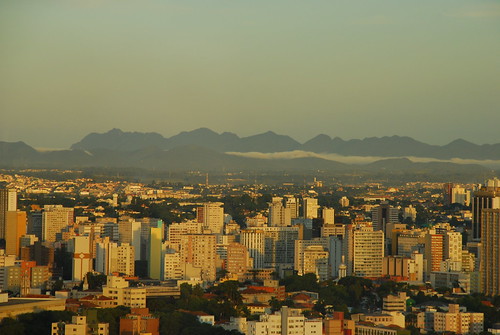
I have arrived in Cape Town, and am currently trying to simultaneously pick up ground on lost sleep and use Table Mountain and the Ocean to oreint myself to the city. While I figure that all out in our hostel for the next few days before we move in with my host family, here is a pretty picture of Curitiba and the coastal mountains that seperate the city from the ocean.
4.3.09
Saudade.
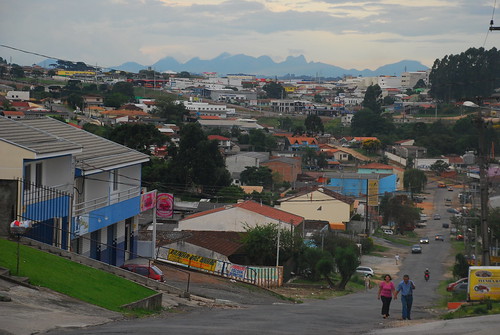
This is where I was living in Curitiba.New York, New York, USA - Jan 19 to Jan 29
São Paulo and Curitibas, Brazil Jan 30 to Mar 4
Cape Town, South Africa Mar 5 to Apr 10
Hanoi, Vietnam Apr 11 to May 15th
Twin Cities this summer! (confirmed.)
Am I seriously already leaving Brazil?
2.3.09

Backlogged...
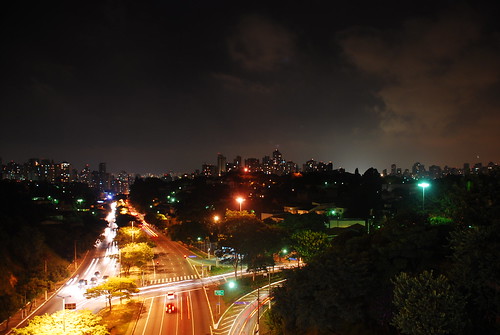
I hate the "OMGZORS I AM A LAME BLOGGERRRRR <3333" entries, as I´m sure you do too. At least my "i´ll get around to blogging eventually" posts come with photos!
But in all seriousness, to prove that I have been furiously scribbling notes in my DSG notebook (don´t ask) about topics related to urbanity and my travels, and to prove it to you, here´s a list of interesting things I may blog about before my flight to Afrique du Sud on Wednesday morning. I assure you that my extensive blogging soon to come will provide much enjoyment and pleasure, and at the very least, a decent set of procrastination for my friends in Minnesota, who I hear just received a gigantic dumping of snow from a blizzard.
1) Carnaval as a sanitized spectacle, stripped of most significant meaning yet still bewilderingly incredible to watch and partake in.
2) Reforma Agrária in Brazil, and my thoughts on challenging the entire system of landownership through which I am familiar with.
3) The phrase "Consuming Culture" (I´ve been thinking about this one for a while, it´ll be a highlight of this blog when it gets cranked out.
3a) Coffee, and milk: how are they different in Brazil, and how is this related to everything from agricultural policy, an ugly history of imperialism and Starbucks?
4) The relationship between São Paulo and Curitiba, the city in which I am studying now. This one will also be a top entry, really.
5) My host family. This blog entry will be a lot less analytical, but they are absolutely, definitely worthy of a few posts of their own. We live outside of the pristine city of Curitiba near unpaved dirt roads, João and Gabriel are both tweens that are simultaneously wonderful and exhausting, their single mom works 65 hours a day at three different jobs, and their extended family of 25 all live on the same block, and there is only one cousin who speaks any english whatsoever. I am, for what its worth, friends with all of them on Orkut, which is pretty much if you put facebook, myspace, a pornography website and a bunch of bright flashing obnoxious colors in a blender and created the ultimate social networking website (which is, of course, owned by Google).
6) The shape of Curitiba. The linear city? Also, the role of starchitects, urban planners, and the "planning elite" who quite literally get to shape the city in placemaking, sustainability, and empowering everybody else. Oscar Niemeyer´s museum, with this huge floating eye, is pretty awesome, but to what purpose?
That is all for now. It is almost four in the morning and I need to finish this ethnography paper. Saudé! Also, a shout out to my loveliest friend Rachel Fortuna; she is having a rough week and you should send your thoughts to her and her beloved dog Macy.
26.2.09
My 13 year old host brother.
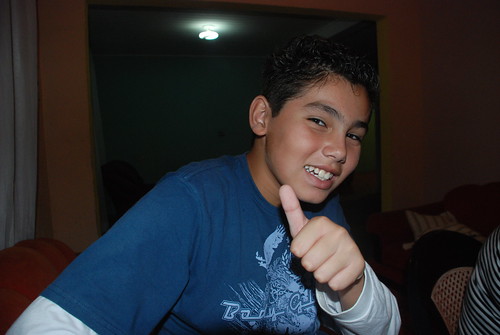
Wait until I tell you about my host family here in Curitiba. I spent the day surrounded by extended family, none of whom speak any english. I met grandmothers, aunts, cousins, and was generally overwhelmed the entire day. I just posted like fifty photos of our visit to the Movimento dos trabalhadores rurais sem terra settlement, go check them out on flickr.
Curitiba is a lot like Portland, and if this is so, we live in the Troutdale of Curitiba.
25.2.09
Good Morning São Paulo
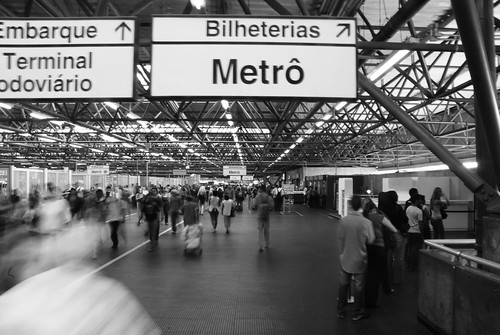
I am currently in a hotel, after being in transit from São Paulo and an MST settlement and heading towards Curitba, where we will stay with a new host family tomorrow. I´m up late for no reason, and i still have a small paper to write for tonight (hooray!), but since Í´m getting lonely and all, here are some addresses to which you should send some postcards. Another girl on the program requested mix CDs of new hip music and of crappy American food, but I´ll settle for updates from the Macalester bubble or from wherever else in the world you might be hanging out.
March 4th through early April:
Aaron Danger Brown
c/o Sally Frankental
Department of Social Anthropology
University of Cape Town
Rondebosch 7701
South Africa
mid April through May 15th.
IHP c/o Hoai Anh Tran
For Aaron Danger Brown
E4 Ciputra Rum 804
Phu Thuong Ward
Tay Ho District
Hanoi, Vietnam
Please keep in mind how fast (read:slow) mail takes, and plan accordingly.
Having the trip of a lifetime.
22.2.09
On "Taking" Photos, Carnival and leaving São Paulo

Portland, Orygun, Cascadia - Dec 15 to Jan 19
New York, New York, USA - Jan 19 to Jan 29
São Paulo, Brazil Jan 30 to Feb 22
Curitibas, Brazil, Feb 25 to Mar 4
Cape Town, South Africa Mar 5 to Apr 10
Hanoi, Vietnam Apr 11 to May 15th
I bought my first digital camera the fall of my senior year of high school, after having a dorky interest in Photography spurned by my father, my friends Sharat and Alex, and a few family vacations where it felt so necessary to capture the essence of wherever I was in some sort of image to take home. It was a respectable Canon point and shoot, and the camera became attached to my right hand by the end of my senior year. My photos were never really that fantastic, but I whored them out on flickr and used a somewhat religious fervor to tag and group my photos to get attention, and I ended up getting a handful of photos into Flickr´s Explore. The winter of my freshman year of college, I bucked up and bought my baby Nikon D80 that I have now, a mammoth DSLR on which I have taken tens of thousands of photos, to multiple music concerts and festivals, through the hottest summer days in Portland to the worst coldsnaps in Saint Paul, to sunrises and sunsets, to at least seven countries, to beaches and cities, to lakes and parties, and even, once, to the top of an active volcano. A year as the school newspaper´s photography editor pushed me to think objectively, as though I was a fly in the room, and to take interesting photos of the boring speakers or new recycling initiatives that inevitably comprised the college´s weekly news. While this screams of an entry from the blog stuffwhitepeoplelike, I am happiest when I am biking somewhere around the Twin Cities, feeling caffeine flow through my system and stopping to whip my camera out of my messenger bag and take a photo of a nice urban landscape. I also invested in some toy film cameras as well, and over the past few months I´ve been slowly working on understanding my dad´s old film SLR that I robbed from his closet about a year ago. Thanks to the degree to which I´ve managed to keep a camera within arms reach over the past four years, I have what I would consider to be a pretty impressive collection of visual images that represents just about everywhere that I have been around the planet for the past three and a half years. Many of my photos aren´t that great (especially the old ones) and I can hardly claim to really, truly understand the intricacies of photography the way that professionals, journalists and artists do, but I enjoy finding ways to frame images, people, and places where I am in some sort of memorable, interesting way.
The point of this blog entry was to ask the simple question: why? Upon looking at my flickr stream, going all the way back to the days in E-hall at Sunset High School, it is pretty interesting to see just how many photos I have taken, how many times I have put a proverbial and literal lens between me and a subject I wished to document. While all those new, flashy point-and-shoot cameras have gigantic LCD screens on their backs and people can take photos while holding their camera at arms length, all of my cameras demand that I look through the viewfinder, thereby inherently distancing myself from a panoramic world in which I stand, and find a limited 4x6 area in which some part of my surroundings are framed and depicted. Furthermore, once I have found a particular frame I wished to leash around a subject, and played with whatever sort of lighting/shutter/apature/film speed/color setting that represents my artistic view on it, I press a button, and the photo is forever stored as a jpg file with thousands and thousands of little pixels of varying hues, waiting for me to find a computer and upload it. And then there! I have proof I saw this particular image, I was somehow related or proximate to this particular combination of time and place, and through the means of the internetz I can show that I WAS THERE.
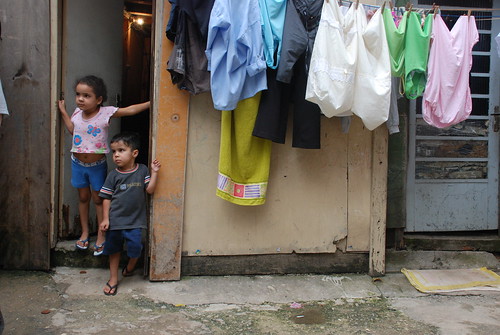
I guess I´m still beating around the bush about the original question, as to why to photograph. As my study abroad program tours Sao Paulo, at any given moment at least 75% of us have cameras on our body, ready at any moment to document any particular moment so that we can upload it to facebook and flickr and impress our friends with the absurd things we´ve seen. Often we pose; hey, look, here I am on top of a very tall building with an incredible view, let it be known that I WAS HERE, and I have moved on to somewhere else where I WILL ALSO BE SEEN, and MY EXISTANCE HERE WILL BE DOCUMENTED. Considering even the cheapest cameras cost about $200, and my baby cost conciderably more than that, and flight travel of almost any sort necessary to visit far away countries is exorbitantly expensive, I often see my desire to chronicle my ability to go to cool places as a luxury, with mobility and documentation as priviledges not afforded to all. This becomes even more frustrating when our program visits Brasil´s sprawling favelas; why am I taking a photo of these kids standing outside their tiny shack of a house? Even more discouraging is when my desires to photograph the shockingly destitute is multiplied among our group as a whole; suddenly, we are the paparazzi, a swarm of mostly-american kids trying to best chronicle what we have seen, and what we will be able to freely escape upon the timely arrival of our bus back to our comfortable homestays. To be fair, these photos can serve a point, and can work towards positive agendas; being able to look through old photographs can help reshape forgotton memories, and there are countless examples of photojournalism and art that have served important causes.
In a related note, Friday night was Carnival. While São Paulo´s Carnival is a shadow of the Carioca parade that will dominate international headlines in the upcoming days, the feat is undoubtedly impressive: at least a dozen samba schools have a full hour to march down the Sambadromo, each school with around three thousand people and divided into subgroups all organized and decorated around a particular theme, with much singing, dancing, euphoria, and nudity. I was fortunate enough to be able to march in the Carnival with the first school of the night, Escola de Peruche, and then watch the rest from the stadium seating that lines the constructed avenue, the sanitized arena that represents the original streets where communities gathered and took over neighborhoods for their own causes. While I have a bazillion thoughts about Carnival and how it might be one of the greatest experiences I´ve had in my entire life, I did not have a camera with me. For the most outlandish, ostentious, colorful, meticulously planned (and framed?) event I´ve ever attended, I went sans camera, since my hulking Nikon would be a bit of a bummer while dancing the Samba in front of the giant crowds. While many of the other kids on the program had cameras and took some incredible photos, (and Hayden´s blog gives a pretty good detail of what went down), I had no choice but to not distance myself from the event and watch the glitter float down from the sky with my own eyes, without the help of a camera lens (although my lenses of my glasses sure helped). Carnival can´t really be documented or described, one of our readings described, only experienced. And I can only conclude that the same is true for travelling in general. In fact, taking photos probably makes it harder to truly experience anything; the necessary fudging with camera controls and calculating light/apature ratings put a strain on one´s abilities to smell the sewage in the water in Diadema, to feel the combination of smog and sweat that hangs heavy in the subway stations, or to even be able to treat others as equals. When I walk in with my 135mm lens and attempt to use it to distance myself from my subject by pressing that shutter button, I am quite literally "taking" a photo; I am not, as photojournalism as a profession and medium so desperately attempts to claim, merely a fly on the wall, but a living, breathing person often attempting to put other living, breathing people into some sort of frame that communicates the world I would be actively describing if I wasn´t actually ratcheting up the shutter speed. Unfortunately, this is something that I can´t immediately resolve without entirely dropping photography, and that´s something I´m hardly prepared to do at the moment. I guess I can only try to continue to be conscious of what I´m taking photos of, and continue to critique myself as to why I want to be seen in a certain environment, why I want others to be seen in a certain environment, and what purpose my photos are serving and will serve as I return home.
I´m leaving São Paulo tomorrow. I´m going to miss this absurd city. I will miss Aldeni, my host mom, and her high-pitched voice and incredible cooking, and I will miss the hyper-concentrated tension that takes shape in everything from the rain clouds to traffic congestion to social inequity, and I will definitely miss the hipster bar Menos we found near Paulista that played Spoon, The Smiths, The Postal Service, Q and not U, Belle and Sebastian, the Breeders, Modest Mouse, and Wilco, but I am excited for a change of scenery. I am looking forward to a breath of fresh air (literally) in Curitibas, and my next host family sent me an incredibly adorable email. Before we go to Curitibas, we´re stopping in with MST, a radical Brazilian land reform group, which will likely prove to be pretty interesting. And on final note, this marks the end of my stay with my roommate here in São Paulo, Michael, who has been absurdly nice in letting me use his laptop to waste copious amounts of time on the internet; expect fewer entries and musings and photographs in the weeks to come.
Return, I will, to Old Brazil...
19.2.09
Subscribe to:
Posts (Atom)
Subscribe To


 Posts
All Comments
Posts
All Comments